The Origin of Empire by Potter David
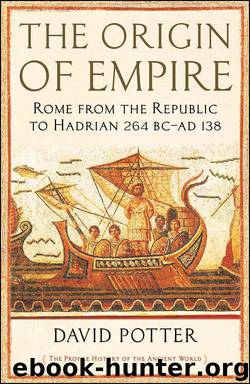
Author:Potter, David [Potter, David]
Language: eng
Format: azw3, epub
Publisher: Profile
Published: 2019-04-17T16:00:00+00:00
20
63 BC
The year 63 BC was a momentous one for three of the individuals whose careers we have been tracing. For Gnaeus Pompey, it was the year in which he ended the Mithridatic war. For Cicero, it was the year in which he became consul. For Gaius Julius Caesar, it was the year in which he won two elections, establishing himself as a rising star in the political firmament. It was also the year of a botched effort by Catiline to overthrow the government.
Pompey had obtained the command against Mithridates in the wake of his spectacularly successful campaign against piracy in the latter half of 67 BC. It had taken him six months to do what none of his predecessors charged with the suppression of piracy across the Mediterranean had managed. And while it would be an exaggeration to claim, as Pompey did, that the threat had been eradicated, the wide-ranging illicit fleets of previous years were no more. Pompey possessed extremely well-developed administrative skills and, despite what his detractors might say (for example, that he had been a teenage assassin), he was not a mass murderer. Recognising that piracy was a lifestyle choice for people living in otherwise economically challenged circumstances in Crete and southern Turkey, he resettled former pirate communities in areas where they might be able to support themselves through agriculture, some of them a long way from home – ex-pirates have been detected in Cyrenaica and even in northern Italy. Aware they could get a deal from Pompey that was markedly better than taking their chances with his legates, Cretan communities sent peace-seeking envoys to him while he was in Cilicia.
While Pompey was dealing with the pirates, the Mithridatic war took a turn for the worse. Mithridates had returned to Pontus in 67 BC, and that autumn had defeated the Roman garrison, then crushed a force commanded by a legate of Lucullus named Triarius (the new governor, Glabrio, would not arrive until the end of the year). With his army on strike, there was nothing Lucullus could do; he was told to hand over part of his army to Glabrio when he arrived, to dismiss the mutinous Fimbrian legions, and to start on the return journey to Italy with those men whose retirement would become final when they reached home. He could not now challenge Mithridates in Pontus, and his replacement as governor of Cilicia, who had elected to intervene in Antioch where the vestigial Seleucid regime had collapsed into chaos, was in no position to do anything about the unravelling situation in the north.
When news of Triarius’ defeat reached Rome, panic seems to have broken out, especially among those who had just taken out the contract for tax-collecting in Asia. No one thought, apparently, that Glabrio would be up to the task. Another solution was both needed, and to hand. On 11 December Manilius, a tribune, introduced a bill to transfer command of the war against ‘the kings’ – Tigranes as well as Mithridates – to Pompey, who, conveniently, was already in Cilicia.
Download
This site does not store any files on its server. We only index and link to content provided by other sites. Please contact the content providers to delete copyright contents if any and email us, we'll remove relevant links or contents immediately.
The Secret History by Donna Tartt(18968)
The Social Justice Warrior Handbook by Lisa De Pasquale(12172)
Thirteen Reasons Why by Jay Asher(8856)
This Is How You Lose Her by Junot Diaz(6844)
Weapons of Math Destruction by Cathy O'Neil(6223)
Zero to One by Peter Thiel(5743)
Beartown by Fredrik Backman(5690)
The Myth of the Strong Leader by Archie Brown(5473)
The Fire Next Time by James Baldwin(5393)
How Democracies Die by Steven Levitsky & Daniel Ziblatt(5182)
Promise Me, Dad by Joe Biden(5120)
Stone's Rules by Roger Stone(5060)
A Higher Loyalty: Truth, Lies, and Leadership by James Comey(4919)
100 Deadly Skills by Clint Emerson(4888)
Rise and Kill First by Ronen Bergman(4744)
Secrecy World by Jake Bernstein(4710)
The David Icke Guide to the Global Conspiracy (and how to end it) by David Icke(4664)
The Farm by Tom Rob Smith(4475)
The Doomsday Machine by Daniel Ellsberg(4463)
